"We believe in honest golf cart repair Tucson can rely on. If a diagnosis doesn’t completely solve the problem, we don't walk away. We take full responsibility for our work and will continue troubleshooting at our expense until we make it right."
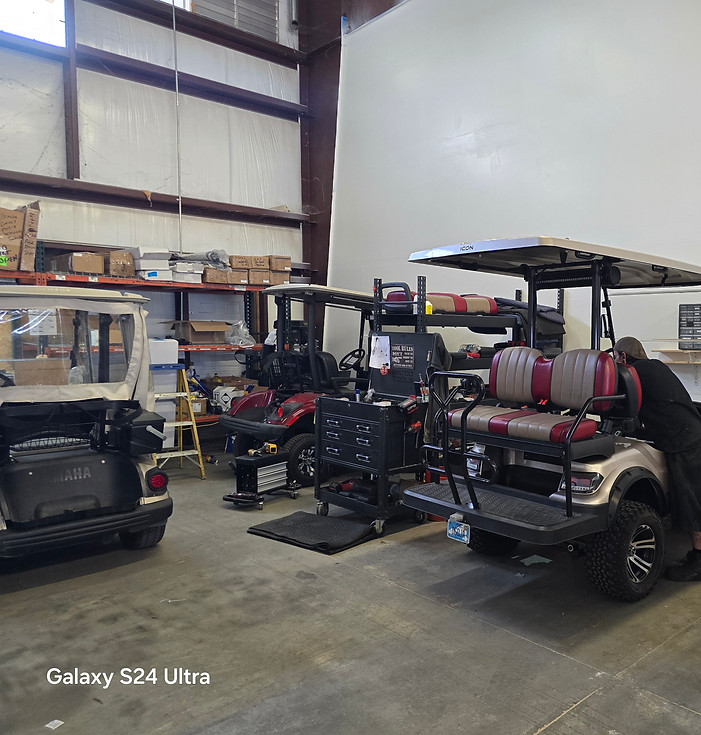
A quick peak at some of the methods to our madness.
We use a methodical process of elimination to diagnose golf cart issues, often starting with the power source before moving down the drivetrain. The diagnosis typically involves a combination of visual inspections, electrical testing with a digital multimeter, handheld programers, software specific programs and mechanical bench tests.
Electrical System: Batteries, Controllers, and Motors
-
Batteries: Technicians begin with a visual inspection for terminal corrosion, swollen casings, or low electrolyte levels. They use a voltmeter to check individual battery voltage and the total pack voltage to ensure the system meets its rated output (e.g., ~51.2V for a 48V system). A load test is often performed to simulate real-world driving; a significant voltage drop under load indicates a failing cell that cannot maintain its capacity.
-
Controllers: If the cart has power but won't move, or exhibits erratic speed behavior like surging, the speed controller is the primary suspect. Shops check for diagnostic trouble codes (DTCs) or flashing operation lights that indicate internal fault. Using a multimeter, they verify input and output voltage at the controller terminals while the accelerator is depressed to confirm if it is properly delivering current to the motor .
-
Motors: For unresponsive carts where the solenoid clicks but there is no movement, technicians perform continuity and ground fault tests on the motor's windings (A1, A2, S1, S2). A bench test may be used, where the motor is bypassed and connected directly to a power source to see if it spins, which isolates it from the rest of the cart's wiring. Worn motor brushes or a burnt smell are common physical indicators of motor failure.
Mechanical System: Rear Axles
-
Rear Axles & Differentials: Mechanical diagnosis often starts by jacking up the rear and listening for grinding or whining noises that suggest a failed bearing or damaged differential gears . Shops specifically look for stripped splines on the brake drum or hub, a common point of failure where the motor spins but the wheels do not turn. They may also manually rotate the input shaft to check for smooth mechanical engagement between the motor coupler and the rear axle assembly.
-
Steering Assemblies: Technicians look for free play or "slop" in the steering wheel, which often points to worn tie rod ends, loose bushings, or a failing steering gearbox. A stationary stress test involves turning the wheel while watching for a delay in tire movement, indicating stripped gears in the rack and pinion. Alignment is also checked; a cart that "wanders" or pulls to one side may require an adjustment.
-
Brakes: Shops start by checking for spongy pedals or excessive travel, which can mean the brake cables need adjustment or have stretched. Drums are pulled to inspect the brake shoes for uneven wear or glazing, and the star wheel adjusters are tested for proper rotation . On hydraulic systems, technicians verify brake fluid levels and check the master cylinder for leaks.
"Ready for a professional diagnosis? Whether you need mobile golf cart service at your door or a full inspection at our shop, you can Book Your Appointment Online Here. Select your preferred date and time, and let our golf cart repair Tucson experts handle the rest."


_edited.png)